

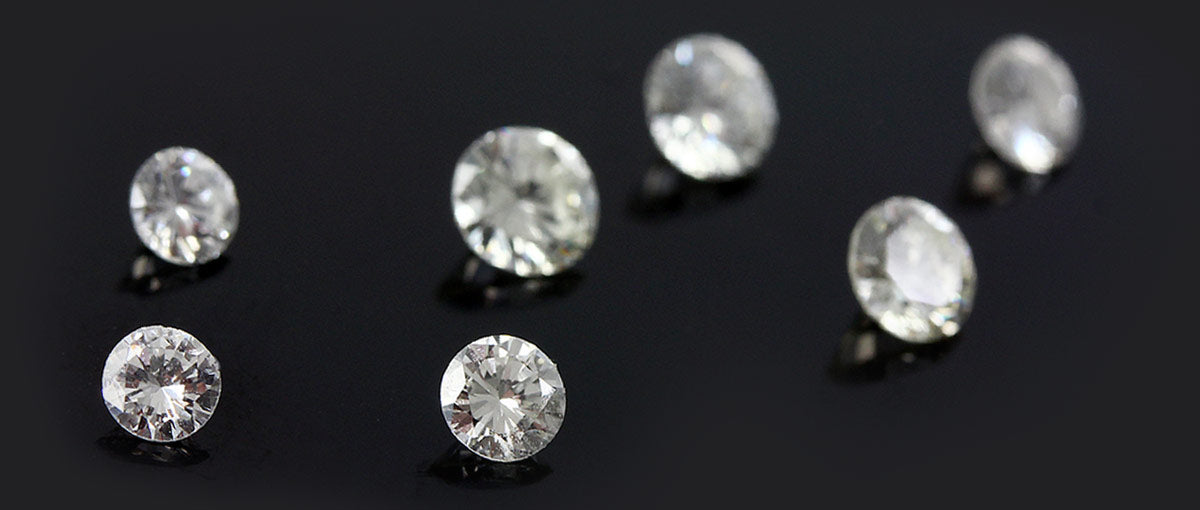

„But square-cut or pear-shaped these rocks don’t lose their shape. Diamonds are a girl’s best friend.” This is a passage from the musical “Gentlemen Prefer Blondes” by Jule Styne and Leo Robin from 1949. Although the song is almost 70 years old and has been featured in so many films that it sounds quite worn out, there is still a spark of truth in the lyrics, as the interest in this gemstone of all gemstones remains unbroken to this day. Worldwide, jewelry and watch manufacturers use diamonds to make their pieces even more valuable. Those who wear diamond jewelry possess prestige and radiate elegance and charisma.
Today, the diamond is the focus of our article, as we want to bring you closer to the value of this gemstone based on the four Cs. The four Cs refer to the English terms Cut (cut), Carat (weight), Color and Clarity (clarity). These classify and price these precious stones.
Cut in Diamonds

The right cut determines the refraction of light in the gemstone and thus whether it can shine in its full beauty. The proportions of the stone play a decisive role. The facets must be well coordinated, and the ratio of the upper part to the pointed lower part must be harmonious. When the proportions are right, the multifaceted radiance and sparkle (the so-called “fire”) arises, which makes the diamond particularly desirable and valuable. A diamond cut too flat or too pointed cannot optimally reflect light and can never develop its full brilliance. The cut thus determines the brilliance of the diamond and therefore its value.
The Most Popular Diamond Shapes:
- Brilliant cut (round)
- Princess cut (square)
- Emerald cut (octagonal, elongated)
- Oval cut
- Marquise cut (oval, pointed at both ends)
- Drop/teardrop cut
- Heart cut
The Brilliant
The term “brilliant” without any addition refers exclusively to a round diamond with a brilliant cut. A brilliant is classified by exactly 57 facets – including the so-called “table,” the large surface on the top of the gemstone. Round-cut diamonds with fewer facets or the so-called octagonal diamonds may not be called brilliants. Of all cut shapes, the brilliant offers the best brilliance because the proportions allow perfect light incidence.
“Hearts & Arrows”
Perfectly cut diamonds in the brilliant cut are also called Hearts & Arrows – diamonds (H&A diamonds). This “ideal” cut reveals a symmetrical pattern of eight hearts and eight arrows when viewed closely in the right light and with special equipment. Hearts & Arrows diamonds are produced with intense fine craftsmanship, which results in higher raw diamond loss. However, these diamonds achieve top prices because their production requires enormous precision.
Carat (Weight) in Diamonds

The size or weight of gemstones is given in carats. One carat (abbreviation ct) corresponds to a weight of 0.2 grams. In antiquity, the seeds of the carob tree were used as a weighing unit because they were believed to have a particularly uniform shape and weight. Modern studies have disproved this uniformity. Nevertheless, a carob seed averages 0.2 grams.
The term “carat” also refers to the carob tree. The scientific name Ceratonia siliqua (carob tree) derives from the Greek term “kerátion” which means “little horn” and refers to the curved seed pods in which the tree’s seeds are found. The carat weight unit is thus meant to recall the carob seed as a comparison unit.
For a more precise idea of the size and weight of a diamond, the following values refer to the diameter of a brilliant:
4.10 mm = approx. 0.25 ct
5.20 mm = approx. 0.50 ct
5.90 mm = approx. 0.75 ct
6.50 mm = approx. 1.00 ct
The largest diamond ever found was named “Cullinan” and weighed a whopping 3,106.70 carats in its rough state. It was cut into 105 diamonds. Nine diamonds are now part of the British Crown Jewels, and the largest stone is owned by the King of Thailand. This diamond is called “Golden Jubilee” and weighs 545.67 carats.
Color in Diamonds
Diamonds are classified on a fixed color scale ranging from D to Z. The color gradations are grouped and each group is named according to the color grade:
D/E – Very fine white (River)
F/G – Fine white (Top Wesselton)
H – White (Wesselton)
I/J – Slightly tinted white (Top Crystal / Crystal)
K/L – Tinted white (Top Cape / Cape)
M–Z – Tinted (Yellow)
The D tone stands for the best categorized diamonds. These are very rare and therefore particularly expensive. Diamonds in colors H to L are the most common.
The yellow tint increases with each group and is mainly visible to the naked eye in the last group (M to Z). For exact color determination, a comparison chart is necessary, as the color gradations in the middle classification groups can hardly be distinguished by the naked eye.
These color gradations only consider colorless to yellow-tinted diamonds. The so-called “fancies”, colored diamonds in colors such as green, blue, or pink, are not included in this grouping.
Clarity in Diamonds

High clarity is also a sign of a precious diamond. The type and number of natural inclusions determine the clarity grade. The fewer inclusions a diamond has, the more valuable it is offered. Diamonds without visible inclusions are called flawless.
Here is a list of international designations:
FL/IF – flawless (free of inclusions at 10x magnification)
VVS – very, very small inclusions, difficult to see even at 10x magnification
VS – very small inclusions, relatively easy to see at 10x magnification
SI – small inclusions, visible at 10x magnification – still eye-clean
P1/P2/P3 – larger inclusions, visible to the naked eye
Included minerals, crystals, cracks, or growth lines inside the diamond are called “inclusions.” Flawless diamonds are very rare and therefore traded at particularly high prices. Inclusions in diamonds classified as P are visible to the naked eye without magnification. Diamonds used for jewelry processing are therefore recommended to have clarity from IF to SI.
The “Fingerprint of Nature”
The diamond is a natural product and can be precisely classified by experts. Nowadays, diamonds are also artificially produced, but even a layperson can often recognize the difference by the lack of brilliance and intensity.
Diamonds only form under extreme conditions: they need millions of years to crystallize. They form from carbon at temperatures between 1,250 and 1,500 degrees Celsius and a pressure of 100 to 150 kilobar. These conditions exist only in the deep layers of the earth at about 150 km depth. Through volcanic activity, rough diamonds reach the earth’s surface and are mined in countries such as South Africa, Brazil, and Russia.
Given this formation process, it is not surprising that diamonds often contain inclusions, cracks, and fractures and sometimes have even grown around a foreign mineral. The latter is called inclusion by experts. These features, which classify the gemstones into clarity grades from VVS to P3, are also called the “fingerprint of nature.”
The four Cs always influence each other. A large stone with many inclusions can have very beautiful brilliance with the right cut. And even yellow-tinted diamonds in the color gradations J to Z achieve top prices if they are perfectly cut, despite some inclusions. If one criterion is less well developed, it can be compensated by the others. Above all, the cut can be influenced by the goldsmith so that the stone shines in its full beauty and is traded as particularly valuable.
About the author

Riko
Further recommendations
![Rolex Yacht-Master steel / platinium automatic women's watch 169622 [2600324]](http://www.zeitauktion.com/cdn/shop/files/2600324_01_nowm.jpg?v=1770815685&width=2400)
![Rolex Yacht-Master steel / platinium automatic women's watch 169622 [2600324]](http://www.zeitauktion.com/cdn/shop/files/2600324_02_2k.jpg?v=1770815686&width=2400)
![Panerai Luminor Due Luna steel automatic unisex PAM01306 [2602673]](http://www.zeitauktion.com/cdn/shop/files/2602673_01_nowm.jpg?v=1779449297&width=2400)
![Panerai Luminor Due Luna steel automatic unisex PAM01306 [2602673]](http://www.zeitauktion.com/cdn/shop/files/2602673_02_2k.jpg?v=1779449299&width=2400)
![Rolex Datejust 18 ct gold automatic women's watch 81208 [2600923]](http://www.zeitauktion.com/cdn/shop/files/2600923_01_nowm.jpg?v=1772196154&width=2400)
![Rolex Datejust 18 ct gold automatic women's watch 81208 [2600923]](http://www.zeitauktion.com/cdn/shop/files/2600923_02_2k.jpg?v=1772196559&width=2400)
![Rolex Lady Datejust steel / gold automatic women's watch 69163 [2604319]](http://www.zeitauktion.com/cdn/shop/files/2604319_01_nowm.jpg?v=1786708573&width=2400)
![Rolex Lady Datejust steel / gold automatic women's watch 69163 [2604319]](http://www.zeitauktion.com/cdn/shop/files/2604319_02_2k.jpg?v=1786708574&width=2400)
![Chopard Happy Diamonds steel quartz women's watch 8236 [2602139]](http://www.zeitauktion.com/cdn/shop/files/2602139_01_nowm.jpg?v=1782114990&width=2400)
![Chopard Happy Diamonds steel quartz women's watch 8236 [2602139]](http://www.zeitauktion.com/cdn/shop/files/2602139_02_2k.jpg?v=1782114992&width=2400)
![Rolex Oyster Perpetual steel / white gold automatic women's watch 6751 Vintage [2601448]](http://www.zeitauktion.com/cdn/shop/files/2601448_01_nowm.jpg?v=1779442097&width=2400)
![Rolex Oyster Perpetual steel / white gold automatic women's watch 6751 Vintage [2601448]](http://www.zeitauktion.com/cdn/shop/files/2601448_02_2k.jpg?v=1779442098&width=2400)
![IWC Mark XII steel automatic women's watch IW442101 [2600937]](http://www.zeitauktion.com/cdn/shop/files/2600937_01_nowm.jpg?v=1772722811&width=2400)
![IWC Mark XII steel automatic women's watch IW442101 [2600937]](http://www.zeitauktion.com/cdn/shop/files/2600937_02_2k.jpg?v=1772722813&width=2400)
![Rolex Datejust steel / white gold automatic women's watch 278274 [2604260]](http://www.zeitauktion.com/cdn/shop/files/2604260_01_nowm.jpg?v=1784290040&width=2400)
![Rolex Datejust steel / white gold automatic women's watch 278274 [2604260]](http://www.zeitauktion.com/cdn/shop/files/2604260_02_2k.jpg?v=1784290041&width=2400)
![Ebel Classic Wave steel / gold quartz women's watch 1057901 [2604450]](http://www.zeitauktion.com/cdn/shop/files/2604450_01_nowm.jpg?v=1784724594&width=2400)
![Ebel Classic Wave steel / gold quartz women's watch 1057901 [2604450]](http://www.zeitauktion.com/cdn/shop/files/2604450_02_2k.jpg?v=1784724595&width=2400)
![Cartier Vermeil silver-gilt quartz women's watch 590002 [2603180]](http://www.zeitauktion.com/cdn/shop/files/2603180_01_nowm.jpg?v=1785246970&width=2400)
![Cartier Vermeil silver-gilt quartz women's watch 590002 [2603180]](http://www.zeitauktion.com/cdn/shop/files/2603180_02_2k.jpg?v=1785246972&width=2400)
![Omega Seamaster steel automatic unisex 212.30.36.20.03.001 [2603003]](http://www.zeitauktion.com/cdn/shop/files/2603003_01_nowm.jpg?v=1780915770&width=2400)
![Omega Seamaster steel automatic unisex 212.30.36.20.03.001 [2603003]](http://www.zeitauktion.com/cdn/shop/files/2603003_02_2k.jpg?v=1780915770&width=2400)
![Universal Geneve steel manual winding unisex 842101 Vintage [2600224]](http://www.zeitauktion.com/cdn/shop/files/2600224_01_nowm.jpg?v=1779078531&width=2400)
![Universal Geneve steel manual winding unisex 842101 Vintage [2600224]](http://www.zeitauktion.com/cdn/shop/files/2600224_02_2k.jpg?v=1779078533&width=2400)


![Blancpain Leman steel automatic women's watch 2360 1191A 55A [2500266]](http://www.zeitauktion.com/cdn/shop/files/2500266_01_nowm.jpg?v=1751058023&width=2400)
![Blancpain Leman steel automatic women's watch 2360 1191A 55A [2500266]](http://www.zeitauktion.com/cdn/shop/files/2500266_02_2k.jpg?v=1747380541&width=2400)
![Breitling Galactic steel quartz women's watch A71356 [2502290]](http://www.zeitauktion.com/cdn/shop/files/2502290_01_nowm.jpg?v=1751060651&width=2400)
![Breitling Galactic steel quartz women's watch A71356 [2502290]](http://www.zeitauktion.com/cdn/shop/files/2502290_02_2k.jpg?v=1747384032&width=2400)
![Bruno Söhnle Glashütte Bologna III gilt / steel quartz unisex 17-23213-292 [2503478]](http://www.zeitauktion.com/cdn/shop/files/2503478_01_nowm.jpg?v=1751063836&width=2400)
![Bruno Söhnle Glashütte Bologna III gilt / steel quartz unisex 17-23213-292 [2503478]](http://www.zeitauktion.com/cdn/shop/files/2503478_02_2k.jpg?v=1750851763&width=2400)
![Cartier Pasha 18 ct white gold quartz women's watch WJ11902G [2501425]](http://www.zeitauktion.com/cdn/shop/files/2501425_01_nowm.jpg?v=1751056264&width=2400)
![Cartier Pasha 18 ct white gold quartz women's watch WJ11902G [2501425]](http://www.zeitauktion.com/cdn/shop/files/2501425_02_2k.jpg?v=1747382692&width=2400)
![Cartier Tank steel quartz women's watch W4TA0004 LP: 5000EUR [2501149]](http://www.zeitauktion.com/cdn/shop/files/2501149_01_nowm.jpg?v=1751056139&width=2400)
![Cartier Tank steel quartz women's watch W4TA0004 LP: 5000EUR [2501149]](http://www.zeitauktion.com/cdn/shop/files/2501149_02_2k.jpg?v=1747382222&width=2400)
![Chopard St. Moritz steel / gold quartz unisex 8023 Vintage [2503002]](http://www.zeitauktion.com/cdn/shop/files/2503002_01_nowm.jpg?v=1751063400&width=2400)
![Chopard St. Moritz steel / gold quartz unisex 8023 Vintage [2503002]](http://www.zeitauktion.com/cdn/shop/files/2503002_02_2k.jpg?v=1750344167&width=2400)
![Glashütte Pavonina steel quartz women's watch 03-01-06-12-02 LP: 7000EUR [2502685]](http://www.zeitauktion.com/cdn/shop/files/2502685_01_nowm.jpg?v=1751061679&width=2400)
![Glashütte Pavonina steel quartz women's watch 03-01-06-12-02 LP: 7000EUR [2502685]](http://www.zeitauktion.com/cdn/shop/files/2502685_02_2k.jpg?v=1748248130&width=2400)
![Omega Constellation steel quartz women's watch 1589.75.00 LP: 8000EUR [2503150]](http://www.zeitauktion.com/cdn/shop/files/2503150_01_nowm.jpg?v=1751063764&width=2400)
![Omega Constellation steel quartz women's watch 1589.75.00 LP: 8000EUR [2503150]](http://www.zeitauktion.com/cdn/shop/files/2503150_02_2k.jpg?v=1750428484&width=2400)
![Omega Constellation steel / gold quartz women's watch 123.20.27.60.55.003 LP: 7200EUR [2501182]](http://www.zeitauktion.com/cdn/shop/files/2501182_01_nowm.jpg?v=1751056556&width=2400)
![Omega Constellation steel / gold quartz women's watch 123.20.27.60.55.003 LP: 7200EUR [2501182]](http://www.zeitauktion.com/cdn/shop/files/2501182_02_2k.jpg?v=1747382287&width=2400)