

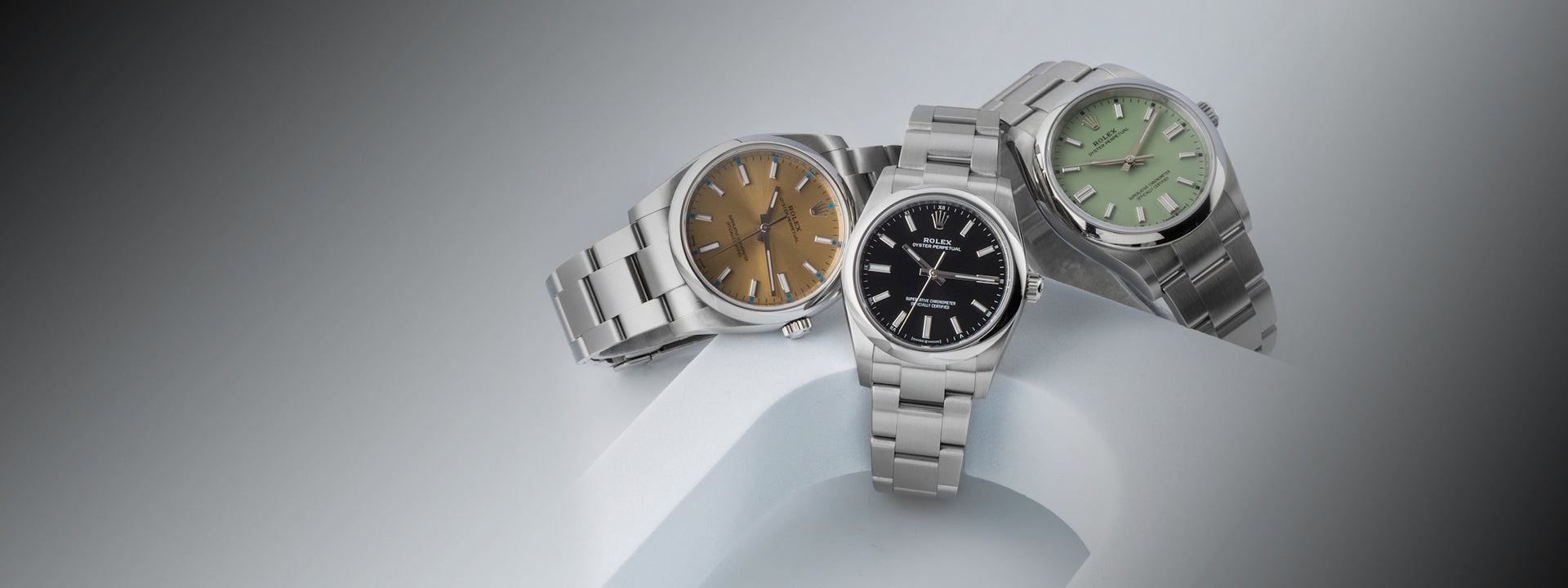
Rolex Oyster: 100 Years of Waterproof Wristwatches

With the introduction of the Rolex Oyster in 1926, Rolex made watchmaking history. The Swiss manufacturer presented the world's first dustproof and waterproof wristwatch, setting a milestone at a time when wristwatches were still considered delicate companions. The name Oyster was deliberately chosen. Like a tightly closed shell, the case reliably protected the delicate movement inside from external influences.
The Beginning Era of Wristwatches
With the dawn of the wristwatch era and the growing recognition of renowned watchmakers in society, the demands for functionality and durability also increased. Dust and water posed a serious risk to many watches. When founder Hans Wilsdorf introduced the Rolex Oyster in 1926, he not only solved an urgent problem. Rather, he created the technical foundation for an entire generation of innovative models that continue to shape the brand's reputation today.
Technical Innovation with the Rolex Oyster

This technical revolution was made possible by a sophisticated system of a screwed bezel, screwed case back, and screwed winding crown. This construction was a masterpiece of watchmaking art at the time and set new standards for robustness and everyday suitability.
Key elements of the design were:
- Screw-down bezel: The glass ring was firmly screwed onto the middle part.
- Screw-down case back: A solid back that hermetically sealed the watch.
- Screw-down winding crown: This was the decisive breakthrough, as the crown is usually the "weak point" for water ingress.
The famous Oyster case still forms the technical and design foundation of most Rolex models today. With this construction, the company consistently emphasizes those qualities that have become the core of the brand: robustness, precision, and absolute reliability in everyday life as well as under extreme conditions.
The early versions from 1926 often appeared in a distinctive cushion shape and with dials in the elegant style of Art Déco. Depending on the model, the case was made of gold or silver, reflecting the aesthetic standards of the time. Only in the following years did the rounder case shapes prevail, which today are inseparably linked with the Oyster line.

Marketing Coup of the Rolex Oyster
A decisive boost for the international fame of the brand came from a spectacular marketing moment in 1927. The British shorthand typist Mercedes Gleitze swam across the English Channel wearing a Rolex Oyster around her neck. For more than ten hours, she battled through the icy saltwater. When she reached her goal, the watch was still functioning perfectly.
Rolex used this triumph for a high-profile advertising campaign and placed a full-page ad on the front page of the Daily Mail. This not only impressively proved the watch's durability but also laid the foundation for the worldwide myth of the brand.
Oyster Perpetual: Performance Description Instead of Model Name

Oyster Perpetual Rolex Deepsea - Photo: Rolex
The term Oyster Perpetual stands less for an independent model line and more for the technical self-conception of a Rolex. It is, in a way, a quality promise on the dial. Oyster refers to the waterproof case, which has set standards in robustness since 1926. The addition Perpetual describes the automatic self-winding mechanism developed by Rolex in 1931, which uses the energy of the wrist to continuously power the watch.
Under the umbrella of Oyster Perpetual are many of the house's best-known model lines. These include the Day Date, the Sea Dweller, the Explorer, the LinkYacht Masteror the GMT Master II as well as many other variants. They all carry the technical DNA of the original Oyster and embody the idea of a reliable, waterproof timekeeper that combines precision and everyday suitability at the highest level.
About the author

Riko
Further recommendations
![Rolex Oyster Perpetual steel / white gold automatic women's watch 6751 Vintage [2601448]](http://www.zeitauktion.com/cdn/shop/files/2601448_01_nowm.jpg?v=1779442097&width=2400)
![Rolex Oyster Perpetual steel / white gold automatic women's watch 6751 Vintage [2601448]](http://www.zeitauktion.com/cdn/shop/files/2601448_02_2k.jpg?v=1779442098&width=2400)
![Rolex Oyster Perpetual steel automatic men's watch 214270 [2604876]](http://www.zeitauktion.com/cdn/shop/files/2604876_01_nowm.jpg?v=1788256147&width=2400)
![Rolex Oyster Perpetual steel automatic men's watch 214270 [2604876]](http://www.zeitauktion.com/cdn/shop/files/2604876_02_2k.jpg?v=1788256148&width=2400)
![Rolex Oyster Perpetual steel automatic men's watch 134300-0012 [2605118]](http://www.zeitauktion.com/cdn/shop/files/2605118_01_nowm.jpg?v=1787316131&width=2400)
![Rolex Oyster Perpetual steel automatic men's watch 134300-0012 [2605118]](http://www.zeitauktion.com/cdn/shop/files/2605118_02_2k.jpg?v=1787316132&width=2400)
![Rolex Oyster Perpetual steel automatic women's watch 177200 [2605592]](http://www.zeitauktion.com/cdn/shop/files/2605592_01_nowm.jpg?v=1789634576&width=2400)
![Rolex Oyster Perpetual steel automatic women's watch 177200 [2605592]](http://www.zeitauktion.com/cdn/shop/files/2605592_02_2k.jpg?v=1789634578&width=2400)
![Rolex Oyster Perpetual steel automatic men's watch 116000 [2604889]](http://www.zeitauktion.com/cdn/shop/files/2604889_01_nowm.jpg?v=1789638991&width=2400)
![Rolex Oyster Perpetual steel automatic men's watch 116000 [2604889]](http://www.zeitauktion.com/cdn/shop/files/2604889_02_2k.jpg?v=1789638992&width=2400)
![Rolex Oyster Perpetual steel automatic men's watch 126000-0005 [2605680]](http://www.zeitauktion.com/cdn/shop/files/2605680_01_nowm.jpg?v=1789470009&width=2400)
![Rolex Oyster Perpetual steel automatic men's watch 126000-0005 [2605680]](http://www.zeitauktion.com/cdn/shop/files/2605680_02_2k.jpg?v=1789470011&width=2400)
![Rolex Oyster Perpetual steel automatic women's watch 76080 [2605419]](http://www.zeitauktion.com/cdn/shop/files/2605419_01_nowm.jpg?v=1789472112&width=2400)
![Rolex Oyster Perpetual steel automatic women's watch 76080 [2605419]](http://www.zeitauktion.com/cdn/shop/files/2605419_02_2k.jpg?v=1789472113&width=2400)
![Rolex Oyster Perpetual steel automatic women's watch 177200 [2604617]](http://www.zeitauktion.com/cdn/shop/files/2604617_01_nowm.jpg?v=1789106174&width=2400)
![Rolex Oyster Perpetual steel automatic women's watch 177200 [2604617]](http://www.zeitauktion.com/cdn/shop/files/2604617_02_2k.jpg?v=1789106175&width=2400)
![Rolex Oyster Perpetual steel / gold automatic women's watch 67193 [2604285]](http://www.zeitauktion.com/cdn/shop/files/2604285_01_nowm.jpg?v=1789044558&width=2400)
![Rolex Oyster Perpetual steel / gold automatic women's watch 67193 [2604285]](http://www.zeitauktion.com/cdn/shop/files/2604285_02_2k.jpg?v=1789044560&width=2400)
![Rolex Oyster Perpetual steel automatic women's watch 177200 [2604340]](http://www.zeitauktion.com/cdn/shop/files/2604340_01_nowm.jpg?v=1785247220&width=2400)
![Rolex Oyster Perpetual steel automatic women's watch 177200 [2604340]](http://www.zeitauktion.com/cdn/shop/files/2604340_02_2k.jpg?v=1785247221&width=2400)
![Rolex Oyster Perpetual steel automatic men's watch 124300 [2605087]](http://www.zeitauktion.com/cdn/shop/files/2605087_01_nowm.jpg?v=1787746868&width=2400)
![Rolex Oyster Perpetual steel automatic men's watch 124300 [2605087]](http://www.zeitauktion.com/cdn/shop/files/2605087_02_2k.jpg?v=1787746870&width=2400)
![Rolex Oyster Perpetual steel automatic men's watch 126000-0013 [2605119]](http://www.zeitauktion.com/cdn/shop/files/2605119_01_nowm.jpg?v=1787315727&width=2400)
![Rolex Oyster Perpetual steel automatic men's watch 126000-0013 [2605119]](http://www.zeitauktion.com/cdn/shop/files/2605119_02_2k.jpg?v=1787315729&width=2400)


![Cartier Tortue 18 ct gold automatic men's watch CRW1548151, W1548151 LP: 173000EUR Limited [2505652]](http://www.zeitauktion.com/cdn/shop/files/2505652_01_nowm.jpg?v=1758869768&width=2400)
![Cartier Tortue 18 ct gold automatic men's watch CRW1548151, W1548151 LP: 173000EUR Limited [2505652]](http://www.zeitauktion.com/cdn/shop/files/2505652_02_2k.jpg?v=1758869770&width=2400)
![Audemars Piguet Royal Oak chronograph 18 ct gold automatic men's watch 26470OR LP: 53000EUR [2605559]](http://www.zeitauktion.com/cdn/shop/files/2605559_01_nowm.jpg?v=1788942906&width=2400)
![Audemars Piguet Royal Oak chronograph 18 ct gold automatic men's watch 26470OR LP: 53000EUR [2605559]](http://www.zeitauktion.com/cdn/shop/files/2605559_02_2k.jpg?v=1788942505&width=2400)
![Rolex Day-Date 18 ct gold automatic men's watch 18038 Vintage [2605019]](http://www.zeitauktion.com/cdn/shop/files/2605019_01_nowm.jpg?v=1789034838&width=2400)
![Rolex Day-Date 18 ct gold automatic men's watch 18038 Vintage [2605019]](http://www.zeitauktion.com/cdn/shop/files/2605019_02_2k.jpg?v=1789034839&width=2400)
![Rolex GMT-Master II steel automatic men's watch 126710BLRO-0001 [2603110]](http://www.zeitauktion.com/cdn/shop/files/2603110_01_nowm.jpg?v=1788942075&width=2400)
![Rolex GMT-Master II steel automatic men's watch 126710BLRO-0001 [2603110]](http://www.zeitauktion.com/cdn/shop/files/2603110_02_2k.jpg?v=1788942076&width=2400)
![Audemars Piguet Royal Oak ceramic / titanium automatic men's watch 26405CE.OOA002CA.01 LP: 54400EUR [2601219]](http://www.zeitauktion.com/cdn/shop/files/2601219_01_nowm.jpg?v=1773055717&width=2400)
![Audemars Piguet Royal Oak ceramic / titanium automatic men's watch 26405CE.OOA002CA.01 LP: 54400EUR [2601219]](http://www.zeitauktion.com/cdn/shop/files/2601219_02_2k.jpg?v=1773055719&width=2400)
![Patek Philippe Gondolo 18 ct gold manual winding men's watch 3599/1 Vintage [2603164]](http://www.zeitauktion.com/cdn/shop/files/2603164_01_nowm.jpg?v=1782737348&width=2400)
![Patek Philippe Gondolo 18 ct gold manual winding men's watch 3599/1 Vintage [2603164]](http://www.zeitauktion.com/cdn/shop/files/2603164_02_2k.jpg?v=1782737350&width=2400)
![Vacheron & Constantin 18 ct red gold automatic men's watch 7800S/000R-B140 [2604767]](http://www.zeitauktion.com/cdn/shop/files/2604767_01_nowm.jpg?v=1788764846&width=2400)
![Vacheron & Constantin 18 ct red gold automatic men's watch 7800S/000R-B140 [2604767]](http://www.zeitauktion.com/cdn/shop/files/2604767_02_2k.jpg?v=1788764845&width=2400)
![Rolex Land-Dweller steel / white gold automatic men's watch 127234 [2604760]](http://www.zeitauktion.com/cdn/shop/files/2604760_01_nowm.jpg?v=1786354109&width=2400)
![Rolex Land-Dweller steel / white gold automatic men's watch 127234 [2604760]](http://www.zeitauktion.com/cdn/shop/files/2604760_02_2k.jpg?v=1786354110&width=2400)
![Rolex Lady Datejust steel / white gold automatic women's watch 279384RBR LP: 18000EUR [2602487]](http://www.zeitauktion.com/cdn/shop/files/2602487_01_nowm.jpg?v=1777549788&width=2400)
![Rolex Lady Datejust steel / white gold automatic women's watch 279384RBR LP: 18000EUR [2602487]](http://www.zeitauktion.com/cdn/shop/files/2602487_02_2k.jpg?v=1777549789&width=2400)